
CoSave
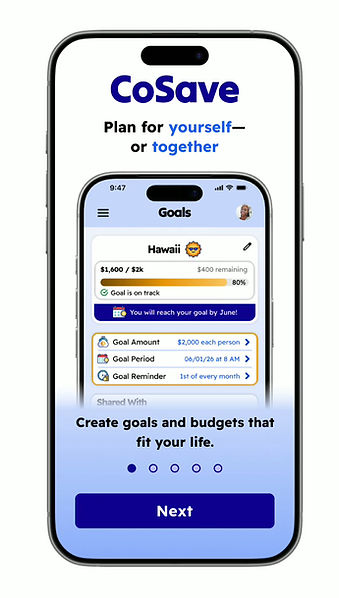
A collaborative budgeting app designed to help groups save, spend,
and stay aligned—without the stress.
.png)
Problem
People who share financial responsibilities struggle to manage money together due to misaligned expectations, lack of transparency, and discomfort around financial conversations. Existing tools focus on individual budgeting and fail to support the emotional and collaborative aspects of shared finances.
solution
Design a collaborative budgeting experience that helps groups manage shared expenses and savings goals with clarity, fairness, and ease—while reducing financial tension and improving communication.
research & discovery
Competitive Analysis:
As part of the discovery phase, I conducted a competitive analysis comparing CoSave to existing budgeting tools such as YNAB. While platforms like YNAB provide strong budgeting frameworks, the research revealed a gap in tools designed specifically for emotionally-aware collaboration, flexible shared contributions, and reducing tension around shared financial planning. These insights helped define CoSave’s unique positioning.
.png)
User Interviews:
To better understand the challenges and expectations surrounding shared financial planning, I conducted user interviews with 10 participants using a structured questionnaire. Questions explored topics such as contribution preferences, household budgeting habits, and desired features for collaborative financial tools. The insights gathered helped uncover common pain points around fairness, communication, and accountability, directly informing CoSave’s feature set and overall design direction.
Key Insights:
Analysis of participant responses revealed several recurring themes: users often rely on fragmented tools such as notes apps, spreadsheets, and messaging platforms to manage shared savings, creating friction around visibility and accountability. Many participants also emphasized the importance of flexible contribution structures, clear progress tracking, and simple visual interfaces. These findings reinforced CoSave’s focus on collaborative transparency, customizable contribution settings, and emotionally supportive design patterns.

80%
Preferred visual progress tracking

70%
Expressed interest in gamification

Wanted flexible contribution options
60%
defining the experience
Primary User Persona:
Meet Quinn Maslo, a representation of CoSave’s core user: someone balancing shared financial goals while navigating the emotional complexities of money management. Quinn’s motivations, frustrations, and expectations informed a design approach centered on collaboration, transparency, and creating healthier financial conversations.

POV Statement + How Might We:
Quinn Maslo needs a way to collaboratively manage shared financial goals with their partner because traditional budgeting tools fail to address the emotional stress, communication barriers, and accountability challenges that come with shared money management.

ideation & planning
User Flow:
To map CoSave’s core collaborative experience, I created a user flow outlining the journey of creating a shared savings goal. This exercise helped identify key decision points, streamline onboarding, and ensure the process of setting up shared financial goals felt intuitive and frictionless for both users.
.png)
Information Architecture & Sitemap:
To organize CoSave’s features into a clear, intuitive structure, I developed a sitemap outlining the app’s navigation hierarchy and core user pathways. This helped ensure users could easily move between budgeting tools, shared planning features, and progress tracking without unnecessary friction.

Low-Fidelity Wireframing + Feature Planning:
Using insights gathered from user research, personas, and ideation exercises, I created paper wireframes to explore early concepts, test information architecture, and plan features that address the emotional and collaborative challenges of shared money management.


visual design
Design System:
To support a consistent and scalable user experience, I developed a comprehensive design system for CoSave that unified typography, color palettes, interaction states, icons, and reusable UI components. Establishing these standards helped create a more cohesive interface while improving accessibility, usability, and overall visual identity.
Accessibility Considerations:
Accessibility was integrated into CoSave’s design system to create a more inclusive and intuitive experience for users. Referencing WebAIM’s accessibility guidelines for designers, I prioritized clear heading structure, accessible color contrast, logical reading order, scalable typography, usable interaction controls, and accessible form elements throughout the interface design.

High-Fidelity Wireframes:
Building on low-fidelity explorations and information architecture planning, I developed high-fidelity wireframes to define CoSave’s visual direction and refine key interactions. These screens showcase the app’s core budgeting and goal-tracking features while emphasizing clarity, accessibility, and ease of collaboration.


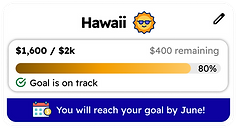
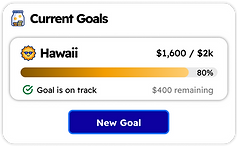
New Goal Walkthrough:
This walkthrough highlights CoSave’s streamlined goal creation flow, allowing users to define goals, customize contributions, set reminders, and invite collaborators with ease.


New Budget Walkthrough:
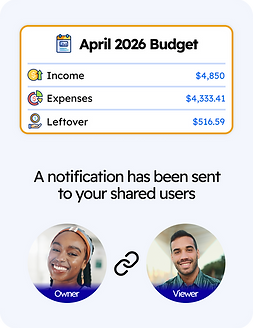
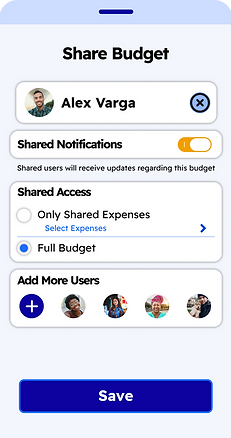
This walkthrough highlights CoSave’s streamlined budget creation process, allowing users to set budget timelines, track income and expenses, and customize shared access settings for a more transparent and collaborative budgeting experience.
testing & iteration
Iteration and Refinement:
CoSave evolved through three rounds of in-person usability testing with 6–9 participants, allowing me to observe user interactions firsthand and gather immediate, actionable feedback. Each round uncovered opportunities to improve the product’s visual hierarchy, aesthetic consistency, and overall user experience.
A recurring theme across testing was the need for stronger visual cohesion. Participants noted that earlier illustrations felt disconnected from the interface and that the color palette lacked energy and distinction. Using this feedback, I refined CoSave’s visual system by updating illustrations, enhancing color contrast, and polishing the interface to better reflect the app’s collaborative and motivating experience.
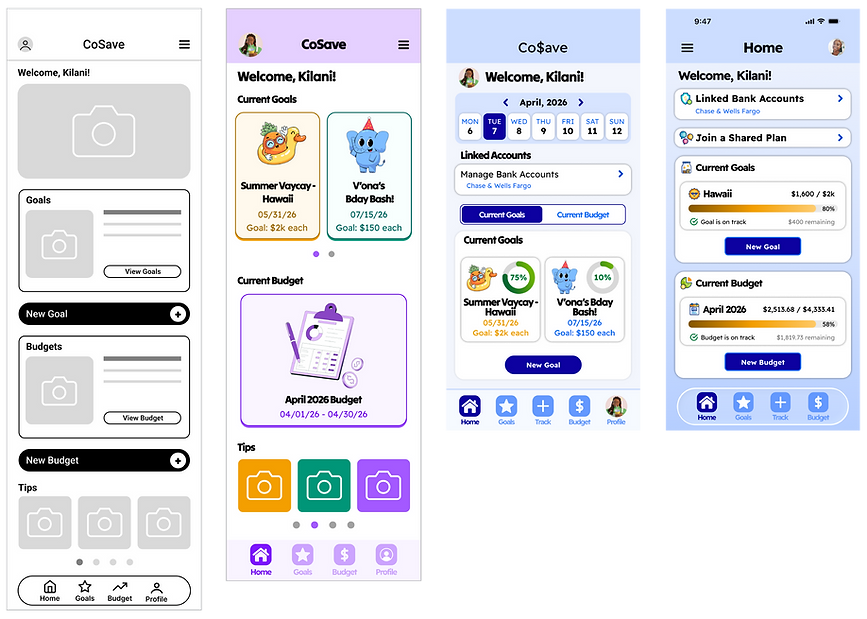
The progression above highlights CoSave’s evolution from foundational wireframes to a polished interface shaped through continuous user feedback.
Users wanted a stronger color contrast
Illustrations felt visually inconsistent
Progress visibility was difficult to scan


Iterations 1 and 2:
The first (purple) and second (blue) iterations highlight CoSave’s visual and functional evolution through user feedback. While the initial design established the foundation for goal tracking, testing revealed opportunities to improve clarity, layout structure, and overall visual cohesion. The second iteration introduced a cleaner interface, improved hierarchy, and more detailed goal inputs such as amount, savings period, and timeline customization.


Final Iteration:
The third and final iteration represents CoSave’s most refined solution, combining user feedback with iterative design improvements to create a cleaner and more intuitive experience. This version incorporates requested progress tracking, simplified goal customization, shared contribution visibility, collaborative notes, and personalized reminders—bringing greater transparency, motivation, and ease to shared financial planning.
conclusion
CoSave marked my first official UX/UI design project and challenged me to thoughtfully balance visual design with user-centered problem solving. Through user interviews, in-person usability testing, and four rounds of iteration, I refined the product based on real feedback and uncovered valuable insights into the complexities of shared financial planning.
This project taught me the importance of designing with empathy, flexibility, and intentionality. It represents not only my growth as a designer, but also my ability to translate research into a functional, accessible, and visually engaging solution built around real user needs.
Moving Forward:
If developed further, I would continue refining CoSave’s emotionally-aware design by exploring features that better support communication, accountability, and collaboration between shared users. Future iterations would focus on expanding group-saving capabilities, enhancing personalized financial insights, and conducting additional usability testing to ensure the platform continues to effectively support users in navigating shared financial goals.